11 Dec 2025
Guide to Search Engine Optimisation vs Generative Engine Optimisation: how to rank in SERP and SGE at the same time
Search is split into two worlds – most businesses still optimise for only one. 2024–2025 marked the biggest shift in the search ecosystem since Google introduced PageRank. Search no longer exists as a single, unified environment.
Today, brands must operate in two parallel systems:
1. Search Engine Optimisation (SEO)
Optimisation for algorithmic, ranking-based systems – Google, Bing, YouTube, local SERPs.
2. Generative Engine Optimisation (GEO)
Optimisation for AI-driven answer engines – Google AI Overviews, Bing Deep Search, Perplexity, ChatGPT Search, Claude Responses, Gemini-powered SERPs and more.
These systems evaluate content differently. They prioritise different signals. They reward different structures. And – critically – they coexist.
The consequence is clear: businesses optimising only for SEO are already losing visibility to generative interfaces that sit on top of traditional search.
At BAMS Digital Marketing Company, we’ve developed a dual-channel methodology designed to secure visibility, authority, and conversion across both ecosystems – with measurable results.
SEO and GEO Are Not Variations of the Same Thing – They Are Two Different Information Systems
SEO: Ranking-Based Retrieval
SEO operates on a retrieval logic:
- Google crawls.
- Google indexes.
- Google evaluates signals.
- Google ranks documents.
SEO focuses on:
- technical infrastructure
- semantic clusters
- content depth
- backlink authority
- E-E-A-T
- UX behaviour
- intent alignment
If you satisfy these criteria, you gain rankings and stable organic traffic. This remains essential.
GEO: Answer-Based Interpretation
Generative engines operate on a reasoning logic:
- The model interprets the question
- It retrieves high-confidence sources
- It synthesises information across inputs
- It generates a consolidated answer.
GEO focuses on:
- factual clarity
- structured information
- entity precision
- cross-source consistency
- attribution confidence
- expert signals detectable by LLMs
- machine-readable content design.
Generative engines:
- do not “rank”
- do not reward keyword density
- do not prioritise backlinks
- do not follow classic search ergonomics.
Instead, they reward content that models can safely use, summarise, and cite.
Why SEO Does Not Automatically Lead to GEO Success
Many companies assume: “If we rank well in Google, AI will also use our content.”
That assumption fails for three reasons:
1. SEO content is often too narrative or commercial
LLMs prefer information-dense, structured, logical, factual content.
Most SEO content is built for humans, not machines.
2. SEO authority does not equal LLM trust
LLMs evaluate:
- entity relationships
- semantic patterns
- factual consistency
- topic certainty.
These signals differ from Google’s ranking algorithms.
3. Generative engines can ignore perfectly optimised pages
A page may rank #1 in Google yet never appear in an AI Overview or ChatGPT’s generated answer because:
- the information is unclear
- the formatting is unstructured
- the page mixes commercial and informational content
- the entity signals are too weak
- the claims cannot be easily validated.
This is why businesses feel invisible “out of nowhere” even with strong SEO.
GEO requires a distinct discipline.
How BAMS Approaches SEO: Foundation Layer
Before a business can succeed in GEO, it must first build SEO authority, because generative engines still reference Google’s ecosystem as a trusted source.
Our SEO methodology includes:
1. Technical Architecture Engineering
- uninterrupted crawl paths
- schema architecture
- multi-level internal linking
- URL and folder logic
- mobile speed optimisation
- accessibility compliance
2. Semantic Ecosystem Mapping
We don’t optimise for keywords – we build topic architectures. This includes:
- parent–child semantic structures
- topical clusters
- long-form hubs
- entity definitions
3. Authority Acquisition
Our link acquisition prioritises:
- editorial placements
- niche publications
- factual citations
- context-rich brand mentions
These feed both Google and generative engines.
4. Conversion-Aligned UX Signals
Google increasingly weighs behavioural metrics; we optimise:
- layout logic
- scroll patterns
- decision prompts
- content readability.
SEO provides the foundation of trust. But GEO multiplies reach.
How BAMS Digital Approaches GEO: Advanced Visibility Layer
Generative Engine Optimisation is where the industry is most unprepared. We built our GEO methodology by analysing:
- SGE/AI Overview behaviour
- ChatGPT Search sourcing patterns
- Perplexity citation logic
- Bing’s retrieval-to-generation pipeline
- LLM training biases
- entity clustering behaviour
- source reliability scoring.
This produced a multi-layer GEO system:
1. Entity-Oriented Content Engineering
GEO starts with entity clarity. We restructure pages so that LLMs can clearly map:
- who the business is
- what the business does
- what problems it solves
- what expertise it has
- what claims are supported by evidence.
This makes the content “safe” for generative models.
2. Answer Framework Design
Models favour content that resembles:
- explanations
- step-by-step structures
- evaluations
- comparisons
- decision frameworks
- factual breakdowns.
We design content so generative engines can lift:
- definitions
- formulas
- criteria
- process flows
- frameworks.
This dramatically improves inclusion.
3. Data Pattern Formatting
LLMs interpret structured data patterns:
- tables
- decision matrices
- pros/cons grids
- workflows
- multi-level lists
- taxonomies
- chronological sequences.
In our tests, pages with structured formats are 3–5x more likely to be cited or used in AI answers.
4. Cross-Source Consistency
GEO punishes contradictions. We build a unified semantic database across:
- main website content
- micro-content
- outreach materials
- social posts
- citations
- PR features
- offsite references.
When LLMs read consistent data across sources, they:
- interpret content as authoritative
- increase probability of inclusion
- reduce hallucination risks
- reinforce entity identity.
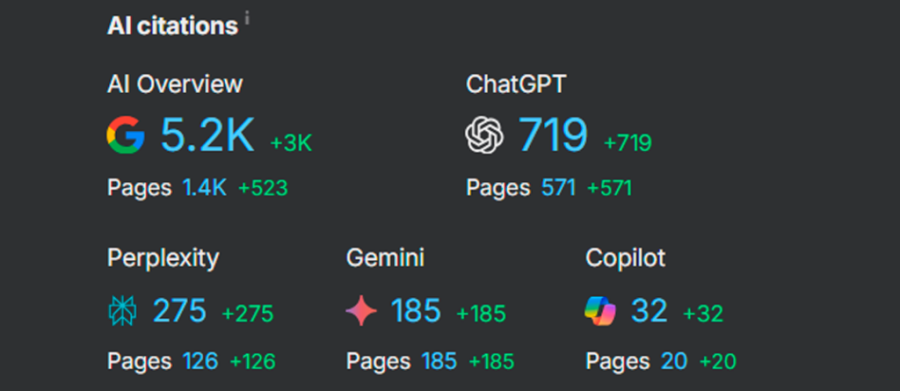
5. Generative Visibility Monitoring
We track:
- AI Overview inclusion frequency
- zero-click exposures
- citation density
- prompt sensitivity
- model hallucination patterns
- cross-engine visibility (ChatGPT, Perplexity, Bing, Claude).
This allows us to adapt content to model updates – which are far more volatile than Google’s ranking updates.
The Future of Search: Hybrid Visibility or No Visibility
By 2027, more than 60% of informational queries will be answered generatively without a traditional SERP step (according to independent industry forecasts we analysed). This does not eliminate SEO – it amplifies its importance. The successful businesses will be those that:- rank high in classic search
- appear inside generative answers
- are trusted by both algorithms and LLMs
- supply models with consistent, structured data
- build entity-based authority.
But the future doesn’t belong to one or the other – it belongs to the companies that learn to operate in ecosystems simultaneously.
BAMS Digital is already there! We don’t optimise for “Google”. We optimise for the entire search universe – retrieval engines and generative engines.
This dual-visibility methodology is no longer optional. It’s the new requirement of digital competitiveness. And businesses that embrace it early will have a structural advantage impossible to replicate later.